As electronic invoicing becomes increasingly important across Ireland and Europe, businesses are encountering a new term: PEPPOL.
PEPPOL is the network that enables organisations to exchange electronic documents, including invoices, in a standardised and secure way.
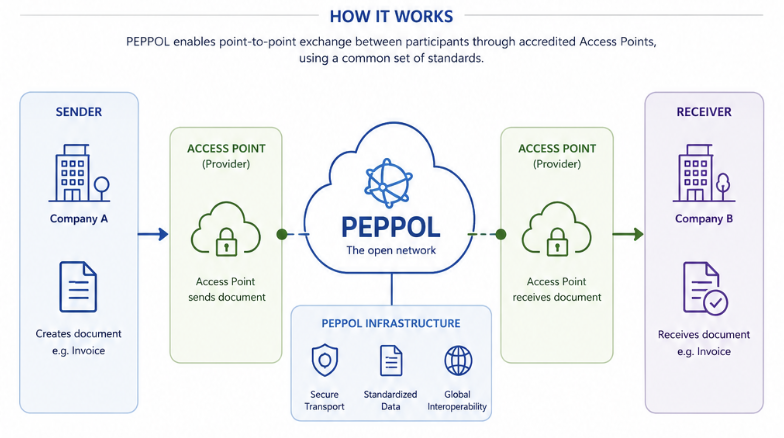
It is already widely used throughout Europe and plays a significant role in public-sector procurement. As e-invoicing adoption grows, understanding PEPPOL is becoming essential for businesses that want to streamline invoicing processes and prepare for future compliance requirements.
What Does PEPPOL Stand For?
PEPPOL stands for Pan-European Public Procurement On-Line.
The project was originally developed to simplify electronic procurement across European countries by creating common standards for exchanging business documents.
Today, PEPPOL has evolved into a global network used by governments, enterprises, and businesses of all sizes to exchange:
-
Electronic invoices
-
Purchase orders
-
Credit notes
-
Order responses
-
Shipping documents
-
Procurement records
Although PEPPOL began as a European initiative, it is now used in many countries around the world.
What Is the PEPPOL Network?
The PEPPOL network is a secure framework that allows different accounting and ERP systems to communicate using common standards.
Rather than each business creating custom integrations with every customer or supplier, organisations connect once to the PEPPOL network and can then exchange documents with any other connected participant.
This approach is often described as:
Connect once, trade with many.
The network creates a standardised way for businesses to send and receive electronic invoices regardless of which software platform they use.
How Does PEPPOL Work?
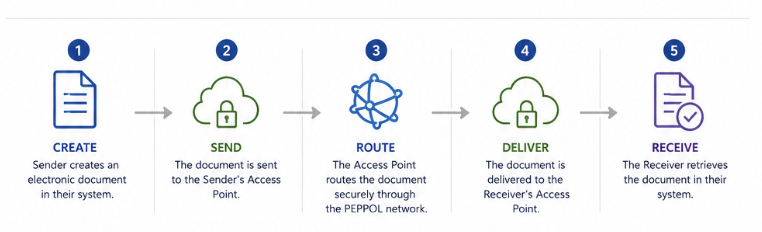
When a business sends a PEPPOL invoice, the process typically follows these steps:
1. Invoice Creation
The supplier creates an invoice using accounting or ERP software.
2. Conversion to PEPPOL Format
The invoice is converted into a structured electronic format that complies with PEPPOL standards.
3. Transmission Through an Access Point
The invoice is sent through a certified PEPPOL Access Point.
4. Delivery to the Recipient
The recipient’s Access Point receives the invoice and delivers it directly into their accounting system.
5. Automated Processing
The invoice can then be validated and processed automatically, reducing manual data entry.
The entire process often takes only a few seconds.
What Is a PEPPOL Access Point?
A PEPPOL Access Point is a certified service provider that connects organisations to the PEPPOL network.
You can think of an Access Point as being similar to an internet service provider.
Just as internet providers connect users to the internet, PEPPOL Access Points connect businesses to the PEPPOL network.
Most organisations do not connect directly to PEPPOL. Instead, they work with an approved Access Point provider.
These providers handle:
-
Network connectivity
-
Document validation
-
Security requirements
-
Compliance updates
-
Technical support
Choosing the right Access Point is often one of the most important decisions when implementing PEPPOL.
What Is a PEPPOL ID?
Every participant on the PEPPOL network has a unique identifier known as a PEPPOL ID.
This identifier acts like a digital address.
When a supplier sends an invoice, the PEPPOL ID ensures it reaches the correct recipient.
Without a valid PEPPOL ID, documents cannot be routed through the network.
Why Is PEPPOL Important?
PEPPOL solves a major challenge faced by businesses and public bodies: interoperability.
Without common standards, organisations often rely on:
-
Email attachments
-
PDF invoices
-
Manual data entry
-
Custom integrations
These approaches can be inefficient, expensive, and prone to errors.
PEPPOL creates a common language that allows different systems to exchange information automatically.
Benefits of PEPPOL
Faster Invoice Processing
Invoices can be transmitted and received almost instantly.
Reduced Manual Work
Structured invoice data eliminates the need to re-enter information manually.
Fewer Errors
Automated validation helps identify issues before invoices are processed.
Improved Compliance
PEPPOL supports standardised electronic invoicing requirements across multiple jurisdictions.
Greater Scalability
Businesses can connect with thousands of trading partners through a single network connection.
Enhanced Security
Invoices are exchanged through secure and authenticated channels.
PEPPOL in Ireland
PEPPOL already plays an important role within Ireland’s public procurement environment.
Many public-sector organisations can receive invoices through the network, allowing suppliers to submit invoices electronically using recognised European standards.
As Ireland moves towards greater digitalisation of VAT reporting and invoicing processes, PEPPOL is expected to become increasingly relevant for businesses beyond the public sector.
Organisations that adopt PEPPOL early may benefit from smoother compliance transitions and improved operational efficiency.
Is PEPPOL Mandatory in Ireland?
PEPPOL itself is not currently mandatory for all businesses in Ireland.
However, electronic invoicing requirements continue to expand across Europe.
The European Union’s VAT in the Digital Age (ViDA) initiative aims to increase digital reporting and structured invoicing requirements over the coming years.
Many experts expect PEPPOL-compatible invoicing standards to play a significant role in future compliance frameworks.
For this reason, many organisations are beginning preparations well before any mandatory deadlines are introduced.
Which Businesses Should Use PEPPOL?
PEPPOL can benefit:
-
Public-sector suppliers
-
SMEs
-
Large enterprises
-
Accountancy firms
-
Manufacturing companies
-
Wholesale distributors
-
Professional services businesses
-
E-commerce organisations
Any business that exchanges invoices regularly can potentially reduce administration costs and improve efficiency through PEPPOL adoption.
How Do You Get Started with PEPPOL?
Implementing PEPPOL usually involves:
Assessing Current Systems
Determine whether your accounting or ERP software already supports PEPPOL.
Selecting an Access Point Provider
Choose a certified provider that meets your technical and business requirements.
Registering for a PEPPOL ID
Your provider will typically assist with registration.
Testing Connectivity
Before going live, invoices should be tested to ensure successful delivery and validation.
Training Staff
Teams should understand any new workflows and compliance procedures.
PEPPOL vs Email Invoicing
Many businesses still rely on email attachments for invoicing.
While convenient, email-based invoicing has several limitations.
| Email Invoice | PEPPOL Invoice |
|---|---|
| PDF attachment | Structured data |
| Manual processing | Automated processing |
| Risk of data entry errors | Reduced errors |
| Email security risks | Secure network |
| Limited validation | Built-in validation |
| Difficult to scale | Designed for large-scale exchange |
Conclusion
PEPPOL is the international network that enables secure and standardised electronic document exchange between businesses and public-sector organisations.
By allowing systems to communicate using common standards, PEPPOL reduces manual work, improves accuracy, and supports future e-invoicing compliance requirements.
As Ireland and the European Union continue their transition towards digital invoicing and reporting, understanding PEPPOL is becoming increasingly important for organisations that want to remain efficient, competitive, and prepared for future regulatory changes.
[/et_pb_text][/et_pb_column][/et_pb_row][/et_pb_section]